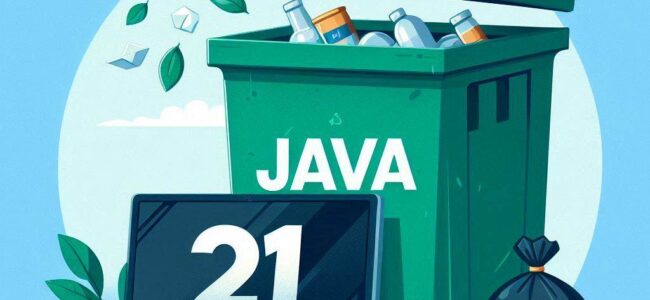
The Ultimate 10 Years Java Garbage Collection Guide (2016–2026) – Choosing the Right GC for Every Workload

First published on foojay.io

Memory management remains the primary factor for application performance in enterprise Java environments. Between 2017 and 2025, the ecosystem shifted from manual tuning to architectural selection. Industry data suggests that 60 percent of Java performance issues and 45 percent of production incidents in distributed systems stem from suboptimal Garbage Collection (GC) behavior. This guide provides a strategic framework for selecting collectors based on workload characteristics. It covers the transition from legacy collectors to Generational ZGC, analyzing trade-offs regarding throughput, latency, and hardware constraints with mathematical precision. Continue reading “The Ultimate 10 Years Java Garbage Collection Guide (2016–2026) – Choosing the Right GC for Every Workload”


The Darkside of AI: Risks and Realities – Talk at Voxxed Days Luxembourg 2025

I’m excited to share the video recording of my talk, “The Darkside of AI: Risks and Realities,” presented at Voxxed Days Luxembourg 2025!

The rapid acceleration of Artificial Intelligence is transforming every aspect of our lives, from how we work and communicate to how we make critical decisions. While the headlines are often filled with the amazing potential and groundbreaking advancements, it’s crucial to pause and critically examine the inherent risks and complexities that come with such powerful technology.

Speaker: Alexius Dionysius Diakogiannis Event: Voxxed Days Luxembourg 2025 Room: AmigaOS

What the Talk Covers

This session went beyond the hype to explore the challenging realities that AI introduces. During the talk, we dove deep into several critical areas:

  • Bias and Fairness: How inherited biases in training data can lead to discriminatory and unfair outcomes, perpetuating societal inequalities.

  • The Ethics of Autonomy: The difficult questions surrounding liability and control as AI systems become more autonomous, especially in high-stakes fields like medicine and transportation.

  • Security Vulnerabilities: Exploring new attack vectors, such as adversarial examples, that can subtly trick AI models, and the risk of AI-driven misinformation campaigns (deepfakes).

  • Socio-economic Disruption: Analyzing the impact of mass automation on the job market and the imperative for proactive reskilling and policy-making.

Unveiling the Dark and Bright Sides of AI: A Deep Dive with Alexius Dionysius Diakogiannis

We are thrilled to share our latest deep dive: “Unveiling the Dark and Bright Sides of AI,” featuring our esteemed guest, Alexius Dionysius Diakogiannis!

The conversation tackles the most critical issues facing AI today, moving beyond the hype to discuss the essential risks and realities.

What We Covered Briefly:

  • Bias and Fairness: The problem of data prejudices shaping AI outcomes.

  • Ethical Control: Who funds and controls AI, and the need for transparency.

  • Cybersecurity & Threats: How AI is used in defense and the reality of attacks like Prompt Injection.

  • Data Privacy: Protecting personal data in the age of massive AI consumption. (

This is a must-watch for anyone who builds, leads with, or simply lives alongside Artificial Intelligence.

Open Conf 2023 Main Panel: The Stay or Return Dilemma for Professionals in Greece

We are pleased to share the video of the Main Panel Discussion from Open Conf 2023: “The Stay or Return Dilemma for Professionals in Greece – Navigating Choices and Overcoming Challenges.” This vital conversation, featuring esteemed guests Dimitris Dimitriadis, Anni Panagiotopoulou, Dimitris Andreadis, and Alexius Diakogiannis, and hosted by Matina Tsavli & Stavros Messinis, delved into the complex factors influencing the decisions of Greek IT professionals—whether to build their careers locally, return from abroad, or remain in the global ecosystem. This discussion is crucial for anyone interested in the future trajectory of the Greek tech sector and its mission to become a strategic global destination.

OpenAI was hit and the Chain of Trust is Broken: Why “Metadata” is Dangerous

I received the email from OpenAI today at 06:23. I read it three times to be sure I understood the technical details. Mixpanel, a data analytics provider that OpenAI used for web analytics has a security incident and data were exposed.

OpenAI says their systems are safe. They say no passwords or API keys were stolen. Many people will read this and think, “I am safe.”

This is a logical error. You are not safe. Continue reading “OpenAI was hit and the Chain of Trust is Broken: Why “Metadata” is Dangerous”

The Dark Side of IT: How US-EAST-1 Took Europe Offline and Why GDPR is in the Crosshairs

The US-EAST-1 Outage Europe's Hidden Cloud Crisis and the GDPR Minefield

Executive Summary

The AWS US-EAST-1 outage on October 20, 2025 demonstrated, once again, that the backbone of Europe’s essential digital services remains tightly, and opaquely, tethered to an Amazon data center cluster in Virginia. European banks, national agencies, and healthcare providers all went dark when a DNS issue in the United States cascaded through global authentication and service management systems, taking down hundreds of companies and affecting millions of users. The incident exposed uncomfortable truths, not just about technical resilience, but also about transparency and compliance with GDPR. Even when EU companies believe their IT operations and data are limited to European regions, hidden architectural dependencies on US-EAST-1 can bring both outages and legal risks. Most critically, end users rarely know when their data, or command functions affecting their data, transit international boundaries.

This article analyses the technical anatomy of the October 2025 AWS outage, identifies specific European companies and sectors hit hardest, and investigates the transparency and compliance failures that allowed a US incident to reverberate throughout the EU. It also explains implications under Schrems II, exposes weaknesses in AWS’s terms of service for European customers, and calls for European CIOs and regulators to demand stronger guarantees, or face a recurrence that risks both business continuity and core data protections. Continue reading “The Dark Side of IT: How US-EAST-1 Took Europe Offline and Why GDPR is in the Crosshairs”

The Dark Side of IT: Ageism in IT, The Invisible Wall of Technology

IT is a field that constantly changes and innovates. It is often seen as a kingdom of youth, freshness, and continuous progress. But behind the shine of startups, hackathons, and endless hours in front of screens, there is a darker side: ageism. This affects not only programmers, but also anyone working around technology, from project managers and analysts to support technicians and sales staff. Continue reading “The Dark Side of IT: Ageism in IT, The Invisible Wall of Technology”

Virtual Threads (Project Loom) – Revolutionizing Concurrency in Java

Project Loom Virtual Threads in Java

Introduction

Concurrency has always been a cornerstone of Java, but as applications scale and demands for high throughput and low latency increase, traditional threading models show their limitations. Project Loom and its groundbreaking introduction of virtual threads redefines how we approach concurrency in Java, making applications more scalable and development more straightforward.

In this post, we’ll go deep into virtual threads, exploring how they work, their impact on scalability, and how they simplify backend development. We’ll provide both simple and complex code examples to illustrate these concepts in practice.

Continue reading “Virtual Threads (Project Loom) – Revolutionizing Concurrency in Java”

The Generational Z Garbage Collector (ZGC)

An image for a blog post with the phrases JAVA 21 and GenZGC prominently displayed

The Generational Z Garbage Collector (ZGC)

The Generational Z Garbage Collector (GenZGC) in JDK 21 represents a significant evolution in Java’s approach to garbage collection, aiming to enhance application performance through more efficient memory management. This advancement builds upon the strengths of the Z Garbage Collector (ZGC) by introducing a generational approach to garbage collection within the JVM. Continue reading “The Generational Z Garbage Collector (ZGC)”

From Java 17 to Java 21 And How To Do It: A Comprehensive API Comparison

An image for a blog post with the phrase JAVA 21 prominently displayed

Introduction

As we all know, Java is a constantly evolving programming language. With each new release, we get a plethora of new features, enhancements, and sometimes, a few deprecations. In this blog post, we will analyse the significant differences between Java 17 and Java 21 API. We will navigate through the changes, with a focus on deprecated features, new library additions, security enhancements, and performance improvements.

Released on September 19, 2023, Java 21 is celebrated for its comprehensive set of specifications that define the behaviour of the Java language, API, and virtual machine. It represents a Long Term Support (LTS) version, ensuring extended updates and support from various vendors, making it a pivotal release for developers and organizations alike. Continue reading “From Java 17 to Java 21 And How To Do It: A Comprehensive API Comparison”